Welcome to your safe space
Is your ego helping you or holding you back?
The power of the ego
2/13/20264 min read
The Power of the Ego: Friend, Foe, or Something More?
In the vast landscape of human psychology, few concepts are as influential—and as misunderstood—as the ego. Some spiritual traditions urge us to dissolve it, while modern self-development frameworks encourage us to strengthen a healthy one.
So which is it?
Is the ego good, bad, or simply misunderstood?
The truth is more nuanced.
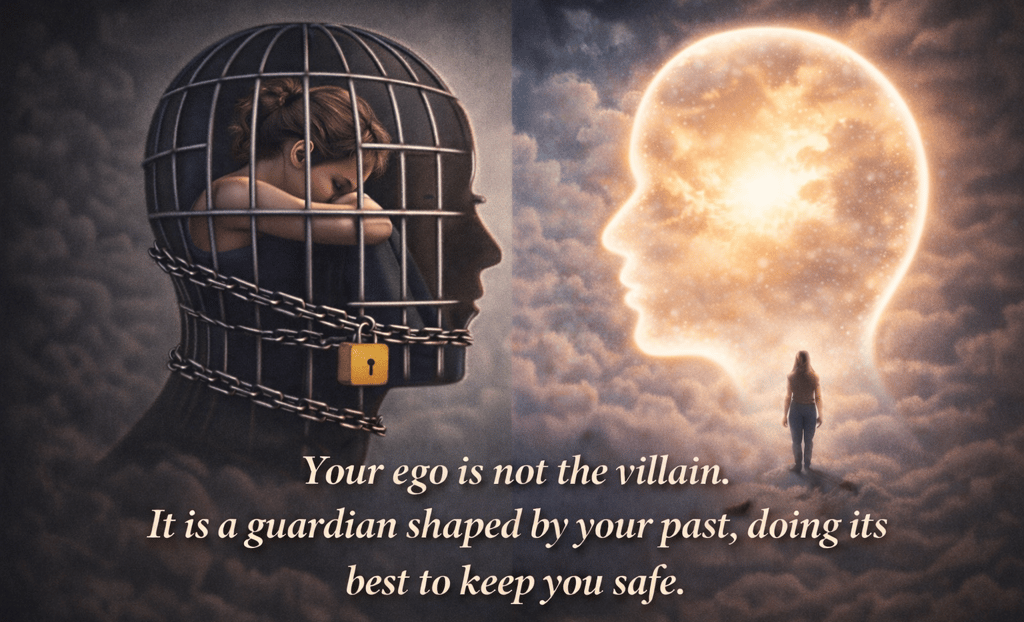
The ego is neither an enemy nor a savior—it is a fundamental part of the human experience, capable of empowering us or trapping us depending on how consciously we relate to it.
What Exactly Is the Ego?
Most people associate “ego” with arrogance, but psychologically, it’s much more fundamental.
The ego is:
your sense of identity
your personal narrative
the internal voice that says “I am”
the mental structure that organizes your thoughts, emotions, and experiences
It helps you function in society, make decisions, and understand your place in the world.
Without it, there would be no stable “identity” to navigate life.
The problem isn’t the ego itself.
The problem is becoming trapped inside its story...
The Power of the Ego
1. It Builds Your Sense of Self
The ego shapes who you think you are—your talents, your limits, your preferences, your role in the world.
A balanced ego allows you to express yourself confidently and set healthy boundaries.
2. It Fuels Ambition and Achievement
Many accomplishments—art, inventions, revolutions—were born from a desire to create, to excel, or to make a mark.
The ego’s drive can be a force for growth and progress.
But when achievement becomes a way to prove worth, the ego becomes a prison.
3. It Protects You
The ego scans for emotional threats—criticism, rejection, vulnerability.
It tries to shield you, often by controlling your reactions or limiting risks.
But this protective instinct can also prevent growth and genuine connection.
The Ego’s Judgment: The Loud Voice in the Mind
One of the ego’s most powerful—and problematic—features is its constant judgment.
This judgment doesn’t only target others; it often turns inward with unrelenting intensity.
The Voice That Never Stops if you don't quiet it
The ego generates a continuous stream of thoughts, commentary, and labels.
It says:
“You should be better.”
“They’re judging you.”
“What if you fail?”
“You’re better than them.”
“You’re not enough.”
This voice is loud because the ego survives through mental activity.
If the mind becomes quiet, the ego feels like it is dissolving—so it clings to thought, noise, and narrative.
How Judgment Controls You
1. It Dictates Your Worth
The ego defines your value based on achievement, appearance, or approval.
It creates an inner pressure to maintain a flawless image.
2. It Triggers Fear and Anxiety
Judgment fuels fear: fear of rejection, fear of mistakes, fear of being “less than.”
The ego interprets everything as a potential threat to its identity.
3. It Reacts Habitually
Judgment causes automatic reactions—defensiveness, comparison, irritation—before you even have time to reflect.
4. It Creates Separation
The ego strengthens the illusion of “me versus you” by constantly ranking, evaluating, and criticizing.
How to Free Yourself From Egoic Control
Freedom does not come from destroying the ego, but from no longer being ruled by it.
1. Become the Observer
The moment you notice the ego’s voice, you separate from it.
Awareness is the antidote to identification.
Instead of being the thought, you become the witness of the thought.
It sounds simple.
It isn’t.
It takes practice. A lot of it.
2. Name the Ego When It Speaks
When harsh or fearful thoughts arise, say:
“This is my ego talking.”
“This is a protective pattern.”
Naming creates distance and reduces the ego’s authority.
3. Interrupt the Story
Ask yourself:
“Is this true or is it fear?”
“Is this judgment useful?”
Just one conscious breath can stop the automatic loop.
4. Practice Stillness and Presence
Silence weakens the ego’s grip.
Meditation, mindful breathing, or even 30 seconds of stillness brings you back to your deeper self—the one beyond the NOISE in your head.
5. Choose Compassion Instead of Judgment
Each act of kindness—toward yourself or others—softens the ego’s rigidity.
Compassion is one of the fastest paths to inner freedom.
6. Return to the Now
The ego lives in the past and future.
Presence lives here, in the moment.
When you’re grounded in the present, the ego becomes quieter because it cannot operate without thought.
Conclusion: The Balanced Ego
The ego is not the enemy.
It is a vital part of being human—a psychological tool that helps you function, create, and grow.
But the ego is not who you are.
When unconscious, it becomes a source of fear, judgment, and disconnection.
When understood and observed, it becomes a servant instead of a master.
True peace begins when you realize:
You are not the voice in your head.
You are the awareness listening to it.
If you’d like to learn more about the ego, here’s a list of books available on Amazon:
The Power of Now: A Guide to Spiritual Enlightenment by Eckhart Tolle https://amzn.to/4qrGOdB
A New Earth: Awakening to Your Life's Purpose by Eckhart Tolle https://amzn.to/4reayfr
Dissolving the Ego, Realizing the Self: Contemplations from the Teachings of David R. Hawkins, M.D., Ph.D. https://amzn.to/4cnyxUI
The Ego Is Not the Real You: Wisdom to Transcend the Mind and Realize the Self by David R. Hawkins https://amzn.to/4rkayuw
Living in the Shadow of the Ego: Unraveling the Layers of Self-Identity and Detaching From the Ego to End Suffering by Tim M Hardtke https://amzn.to/4amXr4g
Connect
Join our community for mindful living.
BREATHE Inspire TRANFORM
info@bloomingmindbody.com
The information on this website is for educational and inspirational purposes only and is not intended as medical, psychological, or professional advice.
Affiliate Disclosure: Some of the links on this website are Amazon affiliate links. This means that, at no additional cost to you, I may earn a commission if you click through and make a purchase. Thank you for choosing to purchase through these links. Your support helps keep this website running.
© 2026. All rights reserved.